 1
Nine rockets are set to launch this week from California, Florida, New Zealand, Japan, and China. SpaceX is set to launch a trio of Falcon 9s this week, delivering two batches of satellites for their Starlink constellation and a rideshare mission. JAXA is set to debut a new variant of its H3 rocket on an interplanetary mission to Mars, and China is set to launch four payloads to orbit. Furthermore, Rocket Lab is set to launch their workhorse rocket, Electron, with a payload for HawkEye 360.
H3-24L | Martian Moons eXploration
On Monday, Oct. 19, the Japanese Aerospace Exploration Agency (JAXA) launched the Martian Moons eXploration (MMX) mission to Mars’ moons Phobos and Deimos aboard the maiden flight of H3-24L. MMX lifted off from pad LA-Y2 at the Tanagashima Space Center in Japan at 19:41 UTC.
The H3 is a two-stage rocket built by Mitsubishi Heavy Industries, powered by two cryogenic stages burning liquid hydrogen and liquid oxygen. The first stage is powered by either two or three LE-9 engines, with zero, two, or four SRB-3 boosters for additional liftoff thrust. The second stage has a single LE-5B-3 engine with the payload mounted atop and enclosed by the payload fairing. The payload fairing can come in one of three configurations: short, long, or wide. Monday’s launch featured the long fairing with the specific configuration designated H3-24L for two first-stage engines, four boosters, and a long fairing.
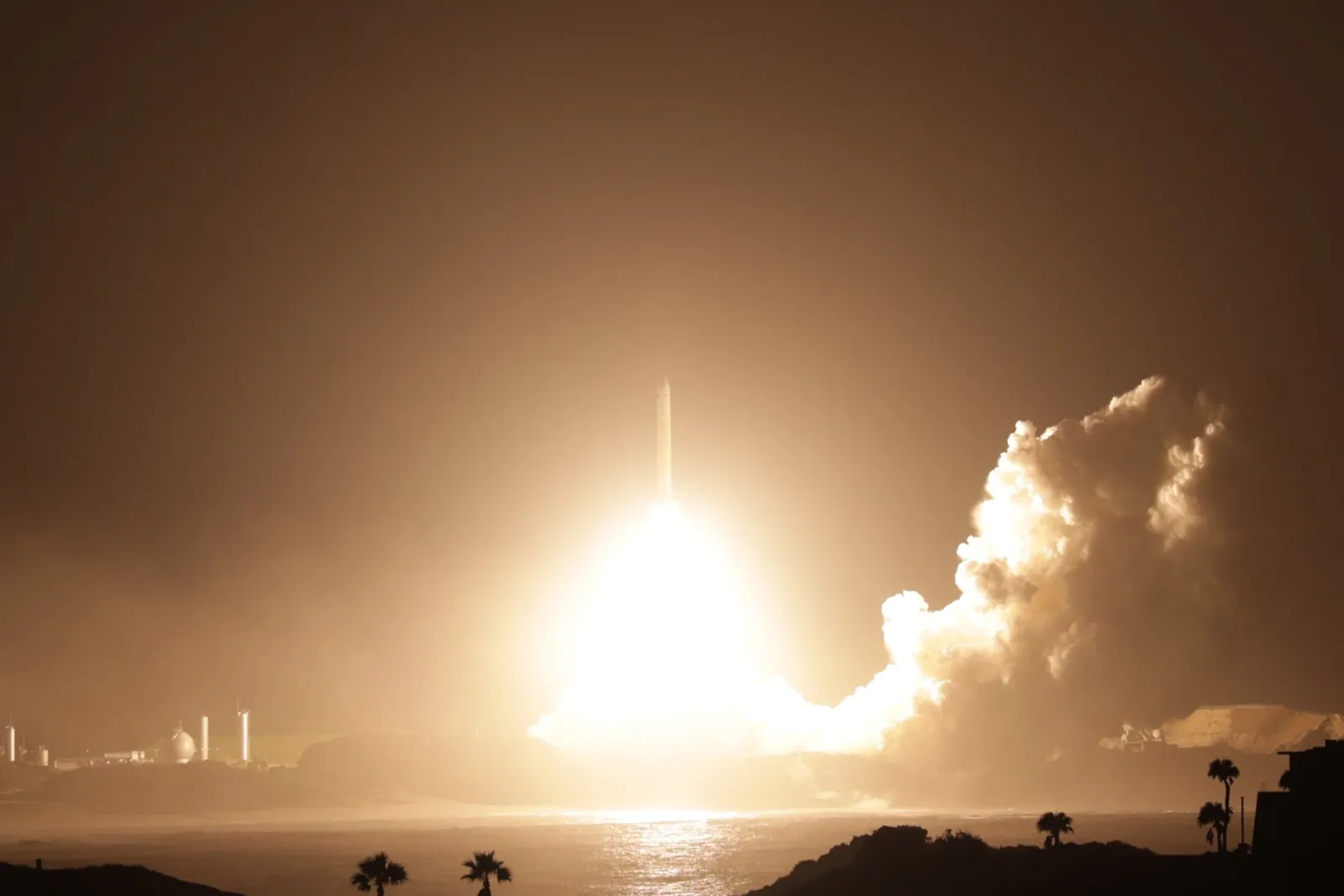 />
H3-24L F10 launches with the MMX probe to study Mars’ moons. (Credit: JAXA)
Following payload deployment, MMX will spend about a year in transit to Mars. Upon arrival, it will enter into a Quasi-Stationary Orbit (QSO) around Phobos. Due to the extremely low masses of the Martian moons, MMX will operate in a QSO, allowing it to maintain a stable trajectory for an extended period while staying close to the moons.
The MMX mission will explore Phobos and Deimos, with a particular emphasis on Phobos. Led by JAXA, MMX will observe the topography, structure, composition, and gravity of Phobos. Additional partners include NASA, France’s Center National d’etudes Spatiales (CNES), Germany’s Deutsches Zentrum fur Luft- und Raumfahrt e.V. (DLR), and the European Space Agency (ESA).
Riding along with MMX is the IDEFIX rover, which will be deployed from MMX at an altitude of 40-100 m above Phobos. IDEFIX is a CNES-DLR-built rover weighing just under 23.5 kg, equipped with instruments that will aid surface observations. After deploying IDEFIX, MMX will land and conduct surface operations, most notably a sampling of Phobos’s surface. MMX’s two sampling instruments are designed to collect about 10 g of soil for return to Earth for further studies.
Additional instruments aboard MMX include: TElescopic Nadir imager for GeOmOrphology (TENGOO), Optical RadiOmeter composed of CHromatic Imagers (OROCHI), Light Detection and Ranging (LIDAR), MMX InfraRed Spectrometer (MIRS), Mars-moon Exploration with GAmma rays and Neutrons (MEGANE), Circum-Martian Dust Monitor (CMDM), and a Mass Spectrum Analyzer (MSA). Following a surface stay, MMX will depart Phobos and spend some time observing Deimos. MMX will depart Mars in 2030 for a roughly yearlong transit back to Earth. The samples collected from Phobos will land in Australia in 2031.
This mission will mark the third H3 flight of 2026. The next H3 launch is expected in the first half of 2027.
Tuesday’s launch schedule features two Falcon 9 launches, with the first flying the Bandwagon-5 mission on a southeasterly trajectory out of Space Launch Complex 40 (SLC-40) at the Cape Canaveral Space Force Station. Liftoff occurred at 7:04 AM EDT (11:04 UTC) during a one-hour launch window that opened at 6:30 AM EDT (10:30 UTC).
SpaceX’s Bandwagon program is a part of the company’s SmallSat Rideshare Program, which allows operators to launch on a dedicated rideshare mission aboard Falcon 9 for lower prices. Bandwagon is accompanied by the Transporter program in this role, with Bandwagon launching to mid-inclination orbits and Transporter launching into polar orbits. This will be the fifth Bandwagon mission for Falcon 9.
Aboard this flight will be 31 payloads in total, 19 from Exolaunch, two from Umbra Lab Inc., two from Tomorrow.io and Capella Space Corp, one from Planet IQ, Varda Space Industries, Planet Labs, Portal Space Systems, Viasat, and Fergani. Bandwagon-5 also launched the second of SpaceX’s Starfall demonstration capsules. Payload deployment began at T+57:18 minutes and will wrap up at T+01:09:17 hours.
Falcon 9 is a two-stage, 70 m-tall, partially reusable rocket that uses nine Merlin 1D sea-level engines on its first stage and a single vacuum-optimized Merlin 1D on its second stage. Falcon 9’s first stage lands either aboard an autonomous droneship or at a landing site, with its fairings being recovered and reused after flight. Both stages utilize RP-1 and LOX as propellants.
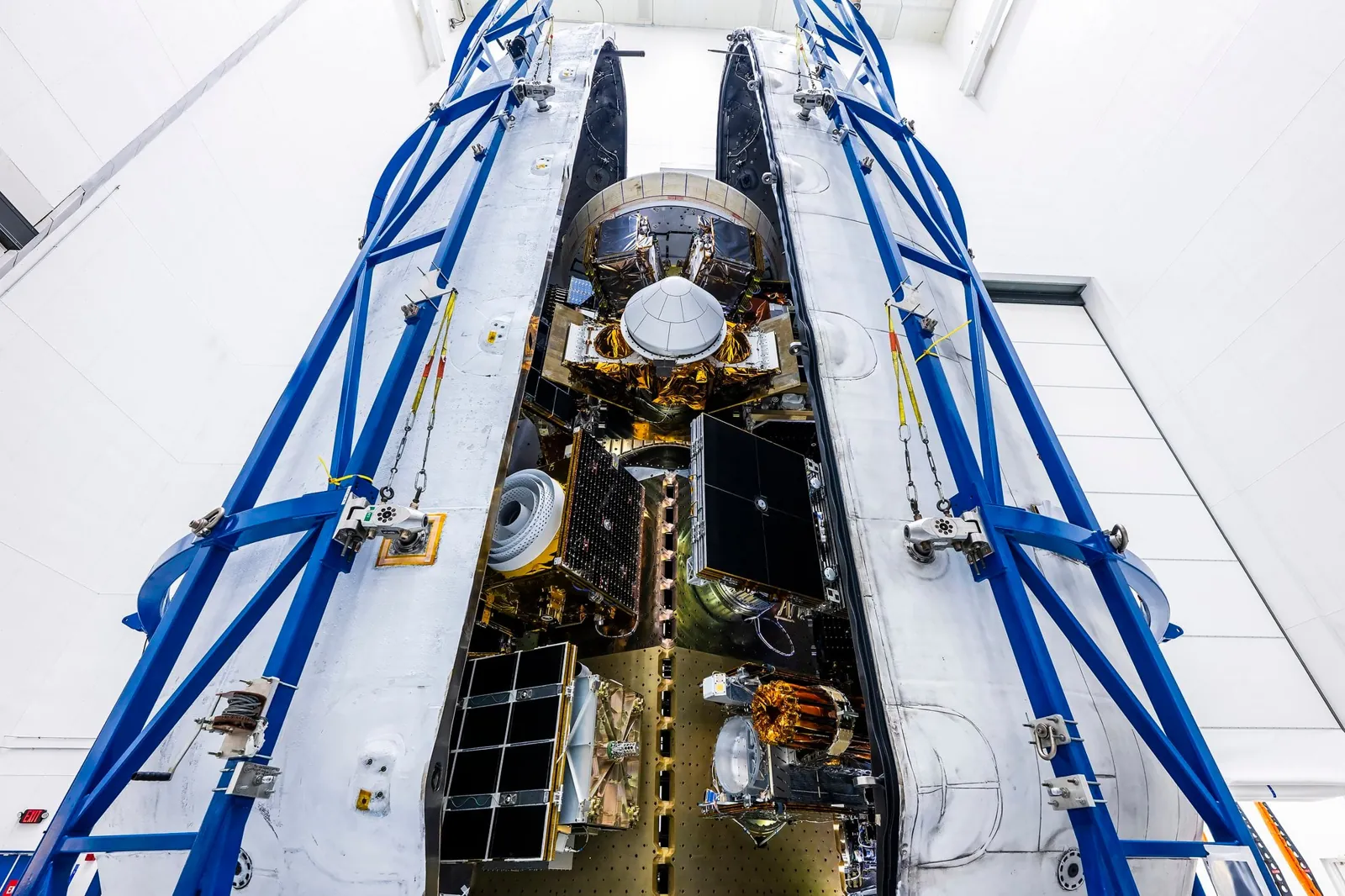 />
The Bandwagon-5 satellite stack ahead of payload fairing encapsulation. (Credit: SpaceX)
This launch was supported by booster B1085, which flew its 19th mission and landed aboard the droneship A Shortfall of Gravitas. B1085 has previously supported the GPS III SV07 (RRT-1), Blue Ghost Mission 1 / HAKUTO-R M2 “Resilience”, SXM-10, MTG-S1/Sentinel-4A, EchoStar XXV, SXM-11, Crew-9, Fram2, and 10 Starlink missions. This mission will mark SpaceX’s 121st launch of 2026.
Falcon 9 | Starlink Group 15-15
Later on Tuesday, Oct. 20, Falcon 9 will launch from Space Launch Complex 4 East (SLC-4E) at Vandenberg Space Force Base (VSFB) in California. The launch window opens at 5:14 PM PDT on Tuesday (22:14 UTC) and will extend until 9:14 PM PDT (2:14 UTC on Oct. 21). Flying a southeastern trajectory, Falcon 9 will carry 27 Starlink v2 Mini satellites to low-Earth orbit (LEO).
Veteran booster B1063 will support this mission, marking its 36th flight. Following stage separation, B1063 is set to land aboard SpaceX’s droneship Of Course I Still Love You. B1063 has previously supported the Sentinel-6A Michael Freilich, DART, Transporter 7, Iridium 9 and OneWeb #19, Transport & Tracking Layer (Tranche 0B), NROL-113, -167, -149, NAOS (LUXEOSys) & Others, and 26 Starlink missions.
China’s first launch of the week is set to fly on Wednesday, Oct. 21, with a Ceres 1S carrying an unknown payload into orbit. Ceres 1S will liftoff from the deck of a converted barge off the coast of Haiyang, flying on a southeast trajectory. Liftoff is currently set for 3:35 UTC, six minutes into a 21-minute launch window.
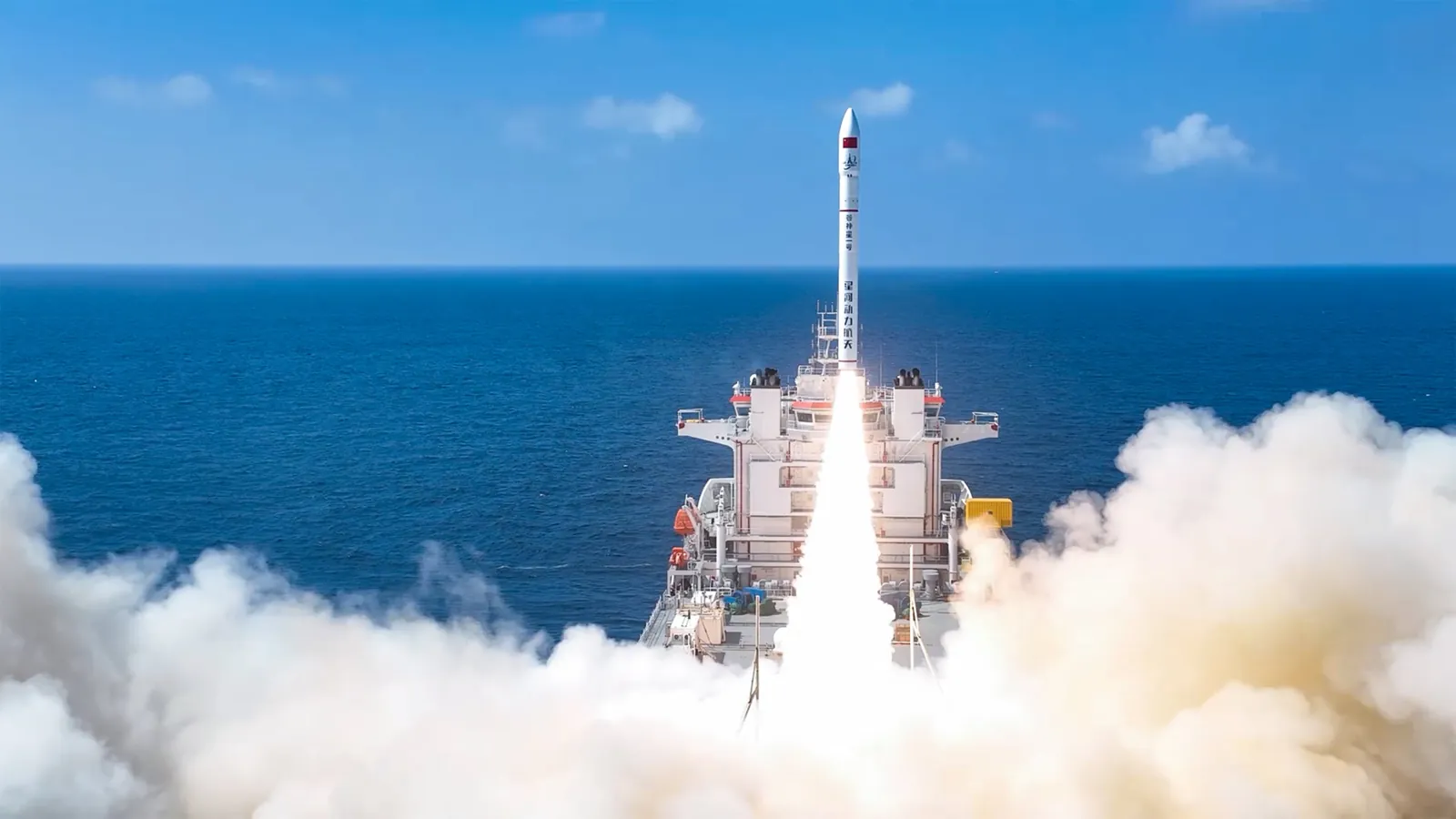 />
Galactic Energy’s Ceres 1S launches from a sea platform at Haiyang Spaceport (Credit: Galactic Energy)
Ceres 1S is the sea-launched variant of Ceres 1 built by Galactic Energy. Ceres 1 is a four-stage small-lift launch vehicle capable of delivering up to 400 kg to LEO. The first three stages are powered by solid propellant, with a fourth using hydrazine for final orbital adjustments. Wednesday’s flight will be the second for Ceres 1 in 2026.
Electron | We’re Not Hawking Around
Scheduled for Wednesday, Oct. 21, Rocket Lab’s Electron is set to liftoff from the Māhia Peninsula in New Zealand. The launch window opens at 05:00 UTC and extends until 8:45 UTC. The vehicle will launch on a southern trajectory to deliver three HawkEye 360 satellites into a Sun-synchronous orbit (SSO).
Electron is a two-stage small-lift vehicle capable of delivering up to 300 kg to LEO and 200 kg to SSO. The vehicle is fueled by RP-1 and LOX, which powers nine Rutherford engines on the first stage and a single vacuum-optimized Rutherford on the second stage. This mission will be Electron’s 98th overall and the 19th of 2026.
Chang Zheng 6A | Unknown Payload
On Friday, Oct. 23, a Chang Zheng 6A (CZ-6A) will launch from Launch Complex 9A (LC-9A) at the Taiyuan Satellite Launch Center in China, carrying an unknown payload. The CZ-6A is currently set to liftoff at 10:15 UTC, eight minutes into a 21-minute launch window that opens at 10:07 UTC.
CZ-6A is a two-stage launch vehicle built by CASC and is powered by RP-1 and LOX. Four solid boosters provide additional thrust at liftoff, allowing the CZ-6A to loft up to 8,000 kg into LEO. Friday’s launch will be CZ-6A’s 28th overall and ninth of 2026.
Chang Zheng 4B | Unknown Payload
Wrapping up China’s launches for the week will be a Chang Zheng 4B (CZ-4B) flying from Site 94 at the Jiuquan Satellite Launch Center on Friday, Oct. 23. Liftoff is scheduled for 18:00 UTC, at the start of a three-hour launch window. CZ-4B will loft an unknown payload into an unknown orbit.
CZ-4B is built by CASC and uses dinitrogen tetroxide and unsymmetrical dimethylhydrazine, both toxic, hypergolic propellants. CZ-4B first flew in May 1999 and has accumulated 58 launches to date, of which 57 were successful. Friday’s flight will be the third of 2026 for CZ-4B.
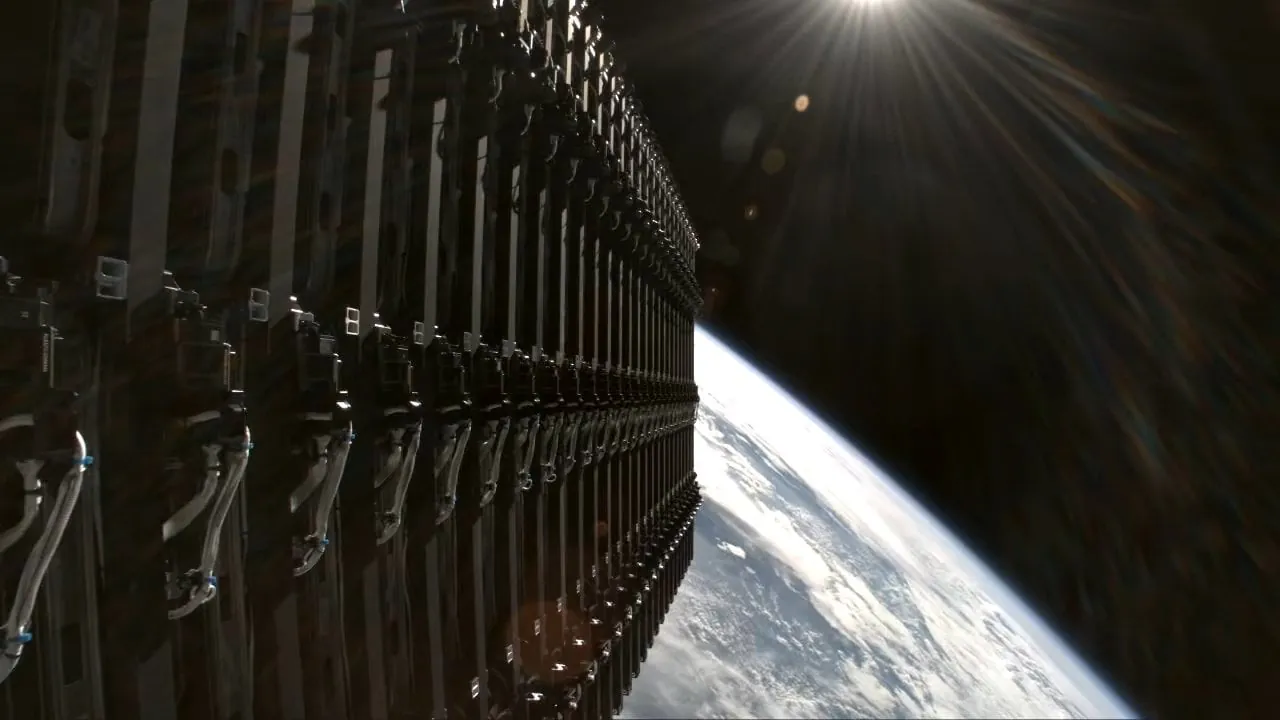 />
Starlink satellites before deployment. (Credit: SpaceX)
Falcon 9 | Starlink Group 15-16
Falcon 9 will wrap up this week’s launch manifest with a Starlink mission from VSFB. The launch window for Starlink Group 15-15 opens on Friday, Oct. 23, at 10:29 PM PDT (05:29 UTC on Oct. 24) and extends until 2:29 AM PDT on Saturday, Oct. 24 (09:29 UTC). Flying a southeasterly trajectory, Falcon 9 will deliver 27 Starlink v2 Mini satellites to LEO.
Falcon 9 booster B1082 will support this mission on its 26th flight, having previously supported the USSF-62 (WSF-M 1), OneWeb #20, NROL-145, Transporter 18, and 21 Starlink missions. B1082 is set to land atop Of Course I Still Love You in the Pacific following stage separation.
Starlink Group 15-16 will be Falcon 9’s 700th mission overall and the 117th of 2026. Furthermore, the mission will serve as the 251st orbital launch attempt worldwide in 2026.
Chang Zheng 8A | Unknown Payload
On Saturday, Oct. 24, China is set to launch a Chang Zheng 8A (CZ-8A) carrying an unknown payload from Commercial LC-1 at the Wenchang Space Launch Site. Liftoff is scheduled for 2:50 UTC, eight minutes into a 25-minute-long window. CZ-8A is built by the Chinese Aerospace Science and Technology Corporation (CASC).
CZ-8A is the upgraded version of the Chang Zheng 8 (CZ-8) launch vehicle and can loft 7,000 kg to LEO. CZ-8A features a larger liquid hydrogen and liquid oxygen-powered second stage with upgraded engines. Thursday’s flight will be the 12th overall for CZ-8A and the sixth in 2026.
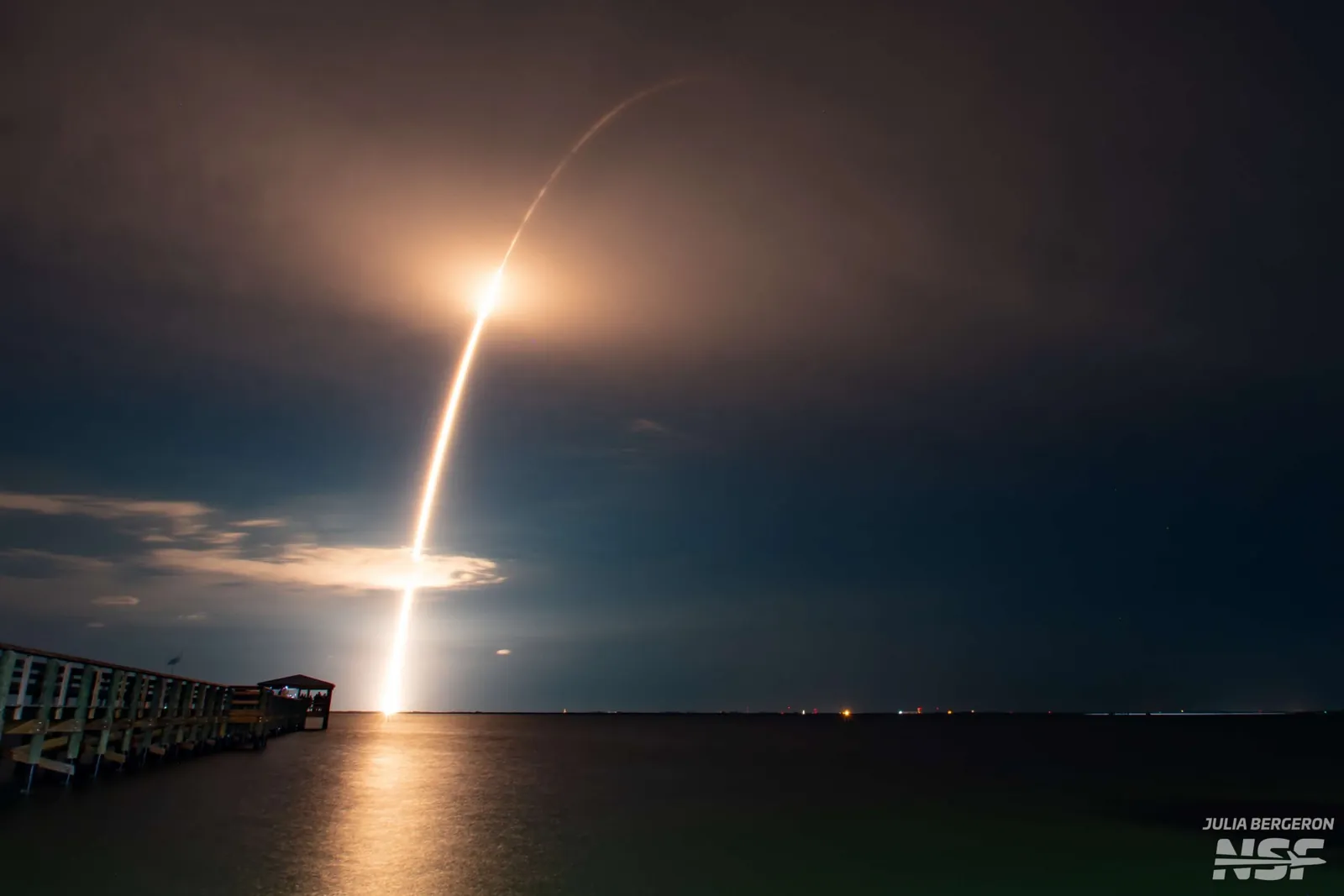
(Lead Image: Falcon 9 launches from Florida. Credit: Julia Bergeron for NSF)
BandwagonChang ZhengchinaElectronFalcon 9H3JAXAMMXRocket LabSpaceXStarlink 0 FacebookTwitterPinterestEmail previous article Falcon 9 launches Bandwagon-5 rideshare mission from Florida />