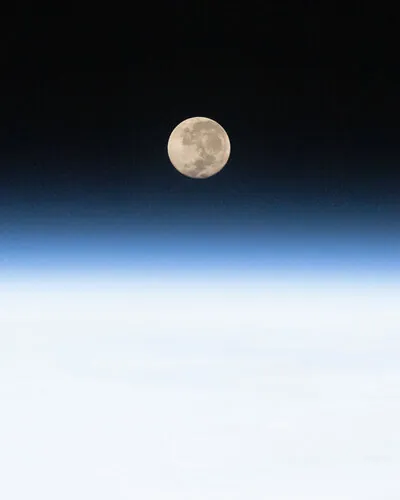
Returning to the Moon is about more than reaching the surface. Before we can live and work there long-term, we need to learn how to operate safely and sustainably in the lunar environment, understand its resources and develop the technologies that future explorers will depend on.
Over the coming years, ESA will fly a series of science investigations and technology demonstrations designed to answer these questions and prepare the next phase of lunar exploration. Through these missions, Europe is building the knowledge and capabilities needed to explore the Moon more effectively and sustainably in the decades ahead.
LandCam-X
Landing safely on the Moon remains one of the most challenging parts of a mission. LandCam-X will fly on Voyager’s Griffin-1 lander and record imagery of the Moon’s changing landscape during descent, providing real mission data to improve autonomous landing systems and make future lunar landings safer and smarter.
MPAc and SOP120
Launching on Intuitive Machines’ IM-3 mission, MPAc will use laser ranging to measure the Earth-Moon distance with unprecedented precision. By improving a technique used since the Apollo era, it will help scientists study the Moon’s interior and test fundamental physics.
The same launch will also carry Scanway’s SOP120 telescope to lunar orbit, from which ESA will purchase landing-site survey data to support future exploration.
Lunar Pathfinder and PLATE
Lunar Pathfinder will become Europe’s first dedicated lunar communications relay satellite and the first element of Moonlight, ESA’s future communications and navigation service for the Moon. The satellite will be placed in lunar orbit during Firefly Aerospace’s Blue Ghost Mission 2. One of its first users will be LuSEE-Night, a NASA radio astronomy experiment that will be delivered to the lunar surface during the same mission.
The same launch will also carry PLATE to the lunar surface, a materials experiment on the wheels of the Rashid-2 rover that will help engineers understand how lunar dust and abrasion affect spacecraft materials.
Prospect
Water ice is one of the biggest questions in lunar exploration. ESA’s Prospect package will travel to the Moon on Intuitive Machines' IM-4 mission, where it will drill up to one metre beneath the south polar surface to collect samples that may contain water ice and other volatiles. A powerful scientific suite will analyse these samples and demonstrate technologies for extracting resources such as oxygen from the regolith, helping scientists understand the Moon's history while assessing resources that could support future explorers. As one of ESA's most ambitious lunar science investigations, Prospect is a major step towards our sustainable exploration of the Moon.
UWB
Future explorers on the Moon will need reliable ways to communicate and locate one another. ESA’s ultra-wideband (UWB) demonstrator will test wireless communications and precise ranging between a lander and rover on the lunar surface. Similar technologies are already used on Earth, but this instrument will assess whether they can support future lunar operations.
EMS
The Exploration Mass Spectrometer (EMS) will investigate the Moon’s extremely thin exosphere, identifying chemical species close to the surface and how they vary from place to place. Flying on the Japanese and Indian LUPEX mission, the instrument will help scientists understand how lunar volatiles such as water move around the Moon and provide new insights into the lunar environment and its history.
RPS
The Rover Permittivity Sensor (RPS) suite will search for water ice hidden beneath the lunar surface. Mounted directly inside a wheel of the Rashid-3 rover, the instrument will measure how regolith responds to electrical signals, allowing scientists to identify possible ice deposits below ground. Its findings will help improve our understanding of lunar resources and their potential accessibility for future missions.
OASIS and ECHO
Long-term exploration requires not just astronauts and rovers but also infrastructure. OASIS is a small lunar service station that can provide power, communications and data handling for science experiments and technology demonstrations, even through the extreme cold of the lunar night, allowing these to operate for years rather than a single lunar day.
The first payloads planned to use OASIS is ECHO, the Environment Characterisation and Heliophysics Observatory. This suite of instruments will investigate the Moon's space environment, from the charged particles and tenuous exosphere above the surface to the abrasive lunar dust that covers it. By improving our understanding of these conditions before lunar exploration accelerates, ECHO will help prepare safer and more sustainable missions to the Moon.
Looking ahead
Collectively, these missions are helping us understand the lunar environment, assess potential resources, and develop the communications, navigation and infrastructure that future missions will rely on. Their findings will help determine how humans and robots can operate safely on the Moon, where future infrastructure could be established, and how future scientific discoveries can be enabled.
ESA is using every opportunity available to build these capabilities step by step through international partnerships, European innovation and a growing range of commercial lunar missions. Working with partners across Europe and around the world, these projects demonstrate a practical and collaborative approach to exploration.
LikeThank you for liking
You have already liked this page, you can only like it once!