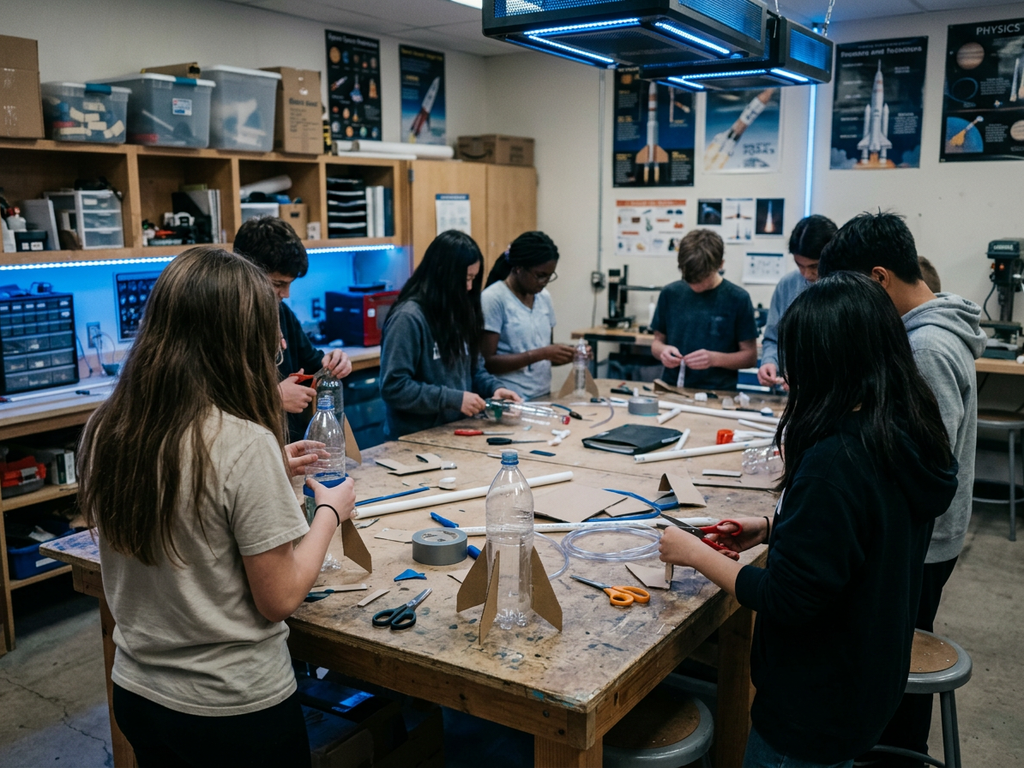
What You'll Need
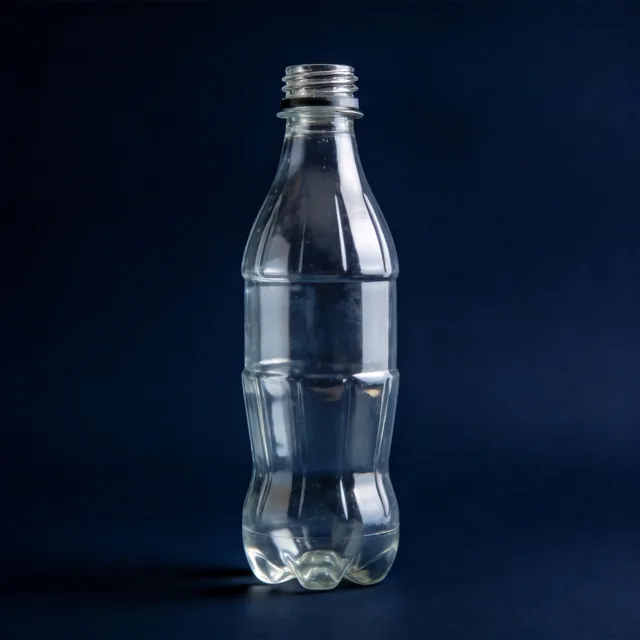
Soda bottleA plastic soda bottle (1–2 liters, PET plastic only) for the pressure vessel — intact, with no scratches, dents, or sun-fading 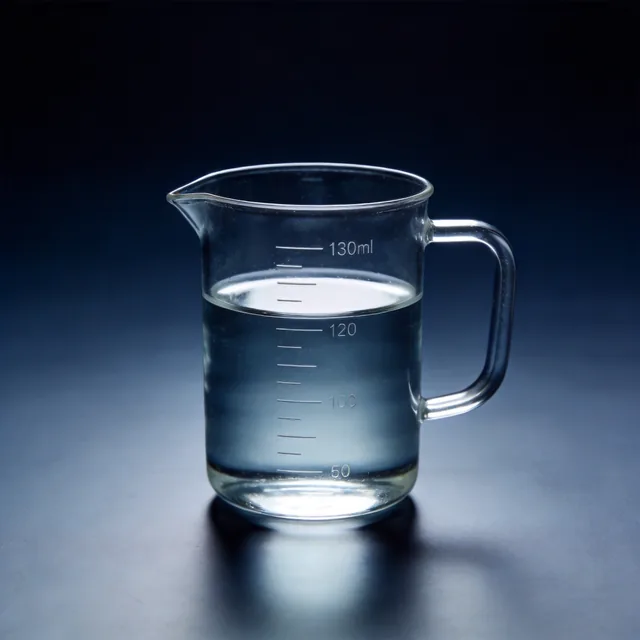
WaterWater, and a way to measure volume 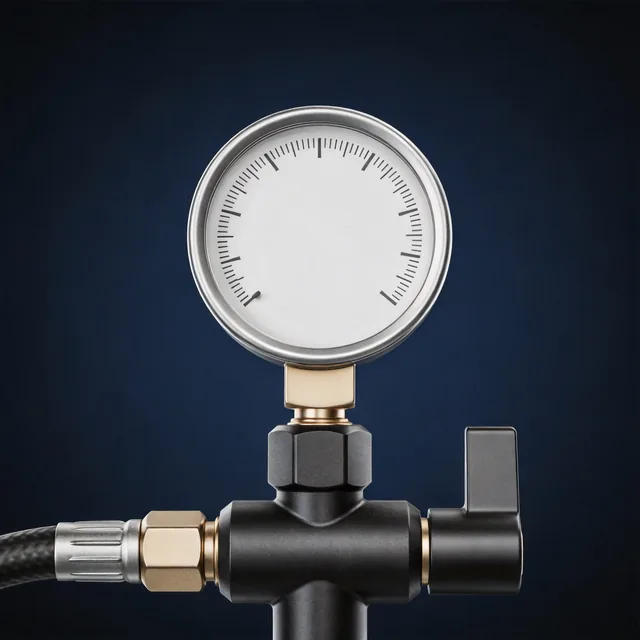
Pump & launcherA commercial water-rocket launcher kit, or a rubber stopper with a bicycle-pump needle, plus a bicycle pump with a pressure gauge 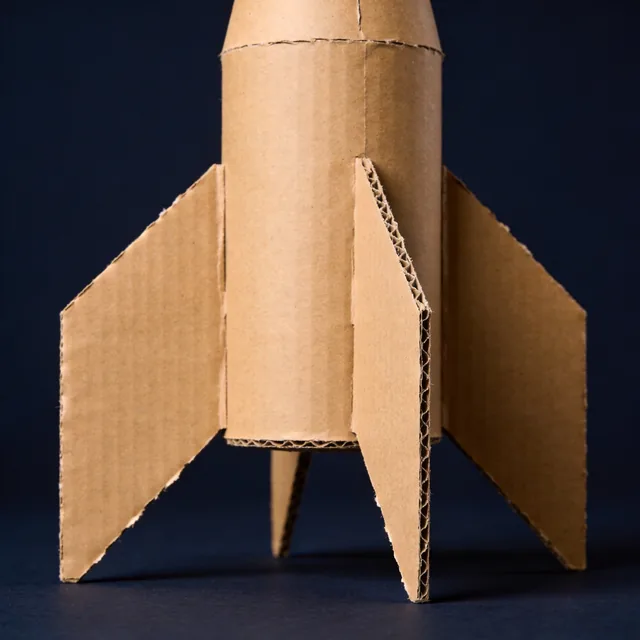
Fins & nose coneCardboard or plastic sheet for three or four fins and a nose cone 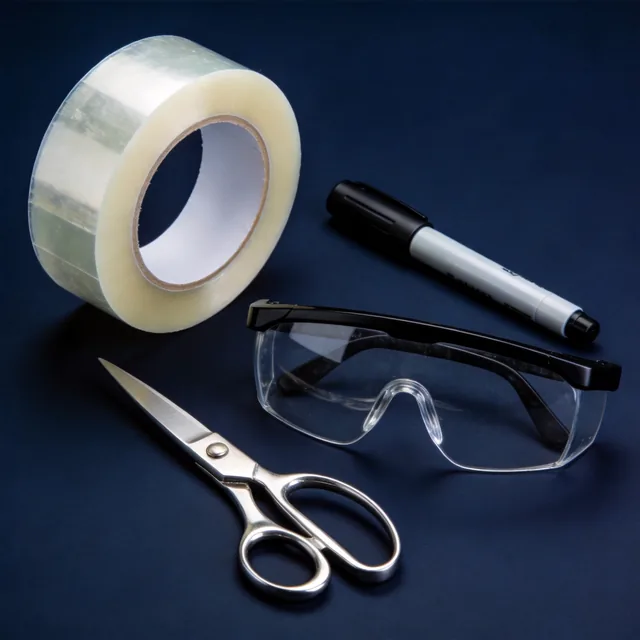
Tape & gogglesTape, scissors, and a marker; safety glasses for everyone at the pad 
Open fieldA large open outdoor area, plus a way to measure height (a protractor clinometer or a phone altimeter app) and a notebook for your flight log
Steps
- Build the airframe: turn the bottle upside down so the opening points down — that end is the engine. Tape three or four triangular fins near the opening, and add a nose cone to the rounded bottom, which now becomes the top.
- Prepare the propellant: fill the bottle about one-third full of water and seal the opening with the stopper or launch valve.
- Set up the pad: place the rocket upright on the launcher in the open field, attach the pump, and move everyone behind the launch line at least two or three meters away.
- Pressurize: pump air into the bottle slowly, up to the pressure your launcher kit specifies — never beyond it.
- Launch: on your countdown, release the stopper or valve. The compressed air forces the water out, and the rocket shoots upward.
- Measure: track the flight and estimate its apex height with your clinometer or app; record pressure, water volume, and fin design for every flight.
- Iterate like an engineer: change one variable at a time — water volume, air pressure, fin shape, or nose cone — then launch again and compare results in your data table.
The Science Behind It
A water rocket is real propulsion, not just a toy. Compressed air stores energy, and when it is released it forces water out of the nozzle at high speed. By Newton's third law, the water pushed downward produces an equal and opposite force that pushes the rocket upward — exactly how a rocket engine throws exhaust one way to move the other way. Water is the reaction mass: it is roughly 800 times denser than air, so pushing water out carries far more momentum than pushing air alone, which is why an air-only bottle barely hops.
Newton's second law explains the rest: acceleration equals force divided by mass, so a lighter rocket or a faster, heavier jet of water means a stronger push. There is a sweet spot around one-third full — too much water makes the rocket heavy and leaves too little room for compressed air; too little water gives the air nothing substantial to throw. The fins provide stability by placing the center of pressure behind the center of gravity, keeping the rocket pointed straight like a dart; a wobbling flight means those two centers are in the wrong order. The nose cone reduces drag. Real rockets obey the same three rules: they burn propellant to produce fast-moving gas instead of using air to push water, and they stage — dropping empty mass — for the same reason your rocket flies best light.
Extend It
- Optimize: systematically vary the water volume (one-quarter, one-third, one-half full), keep everything else constant, and graph the heights — find your sweet spot.
- Test fin designs: three fins versus four, large versus small, and record the effect on stability.
- Add recovery: build a parachute from a light plastic bag so the rocket descends slowly and can fly again.
- Carry a small payload, such as a wrapped "sensor" bead, and measure how extra mass changes the flight.
- Sketch a two-stage version and explain which stage of a real rocket each bottle represents.
Safety Notes
Launch only outdoors, in an open area far from people, cars, buildings, windows, and power lines, and never toward roads. Adult supervision is required. Everyone near the pad wears safety glasses. Never exceed the pressure your launcher kit specifies, and never pressurize indoors. Inspect the bottle before every flight and replace any bottle that is scratched, dented, or faded by sunlight; never use glass bottles. Never stand over a pressurized rocket, and keep everyone behind the launch line. If a rocket fails to launch, release the pressure from a distance and wait before approaching. Clear the landing zone before every countdown.