Course Overview
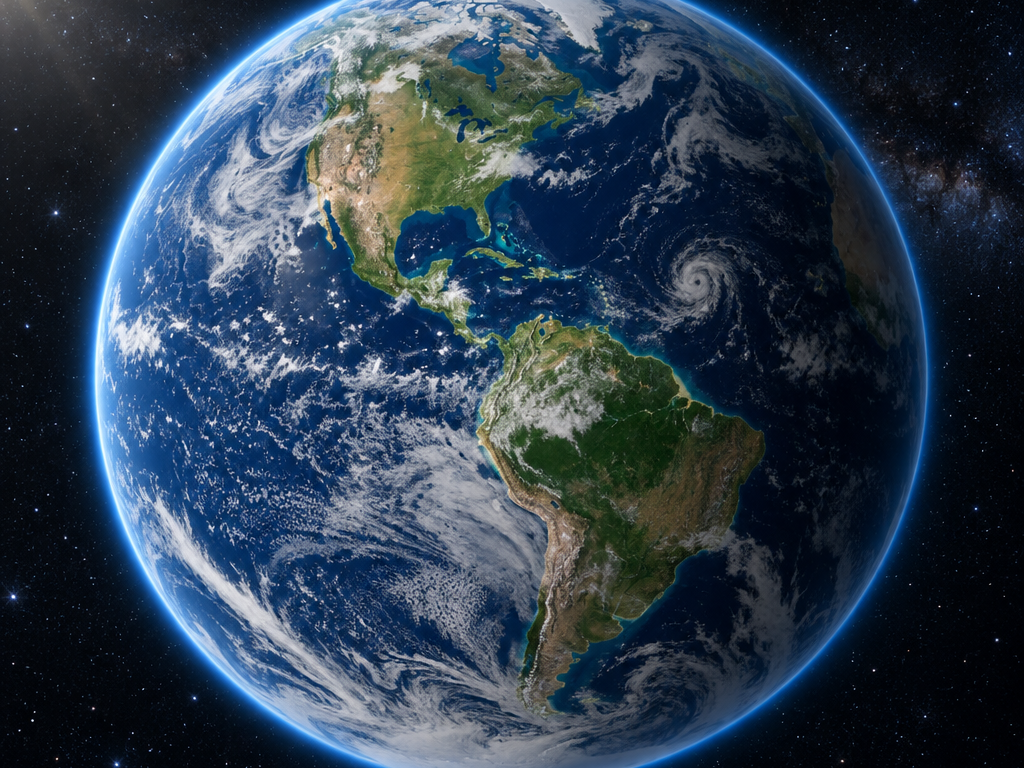
Young students explore what makes Earth special — land, water, air, and life — and learn why we must protect our planet. About 71% of Earth's surface is ocean, yet nearly all of Earth's water is salty, and the thin atmosphere overhead is mostly nitrogen and oxygen. Through observation, sorting games, and simple demonstrations across four 30-minute lessons, students build early science skills while discovering why Earth, so far, is the only known home for life.
Learning Objectives
By the end of the unit, students will be able to:
- Identify Earth's major features: land, oceans, atmosphere, and living things.
- Describe the water cycle in simple terms.
- Explain what makes Earth a good home for life (liquid water, breathable air, a protective atmosphere, and the right temperature).
- Suggest simple ways to care for the environment.
Key Concepts
- Earth is mostly covered by ocean water — about 71% of the surface — but almost all of Earth's water is salty; fresh water that we can drink is rare.
- The atmosphere, about 78% nitrogen and 21% oxygen, shields us from harmful rays and keeps temperatures livable.
- Earth spins once every 24 hours to give us day and night, and its 23.5-degree tilt gives us seasons.
- Our one Moon, about 384,000 kilometers away, pulls ocean tides and helps keep Earth's tilt steady.
- The Sun's steady energy powers Earth's weather and the water cycle, and it has allowed life to thrive for billions of years.
- Living things need air, water, food, and a safe place to live — and everyone can help by reducing, reusing, and recycling.
Lesson Sequence
- Lesson 1 – Our planet: globe observation; find land, oceans, and where we live; introduce day and night with a lamp and a spinning globe.
- Lesson 2 – Water, water: build a water-cycle model in a bag on a sunny window; talk about why fresh water is precious.
- Lesson 3 – What makes Earth special: picture sort of things Earth has that help life; compare with the Moon and Mars and ask what is missing there.
- Lesson 4 – Planet protectors: make a caretaker pledge, start a classroom recycling habit, and share favorite places on Earth.
Classroom Activities
- Globe observation: find land and water on a globe or map and describe what they see.
- Water-cycle model: seal a small amount of water in a plastic bag on a sunny window to show evaporation and condensation.
- Day and night demonstration: shine a lamp on a slowly turning globe and watch "daytime" and "nighttime" move around it.
- "What makes Earth special?" picture sort: sort picture cards into things Earth has that help life.
- Caretaker pledge and show-and-tell: each student draws or writes one way they can help protect the planet, then shares one favorite place on Earth and why it is special.
Safety Notes
Only the teacher handles the demonstration lamp — it gets hot. Use scissors with adult help and rounded-tip scissors for younger students. Remind students never to stare at the real Sun, indoors or outdoors. Wipe up any water spills from the water-cycle activity right away. Check for plant or mold allergies before any seed-planting extension.
Extension Ideas
- Plant a seed and track how water, air, and light help it grow.
- Start a classroom recycling or energy-saving habit and chart it for a month.
- Compare Earth to the Moon or Mars and discuss what is missing there for life.
- Draw "Earth from space" and point out one thing that protects us (atmosphere, magnetic field, Moon).