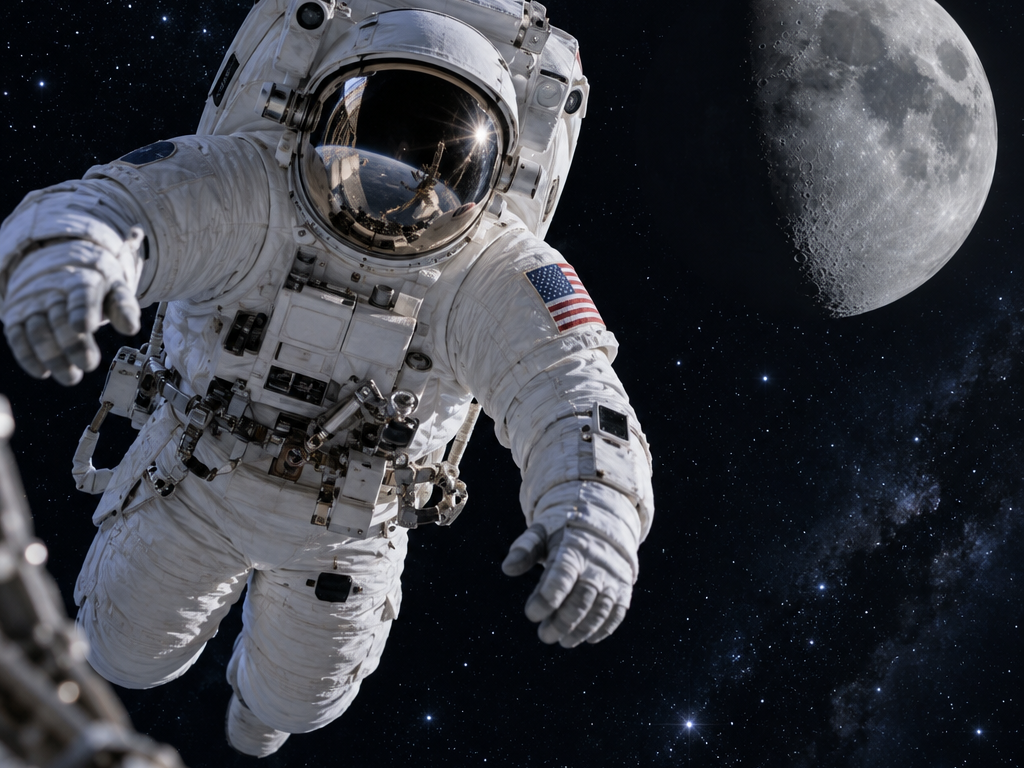
Course Overview
Students discover how astronauts live, eat, sleep, exercise, and work aboard the International Space Station, and how microgravity affects the human body. The station circles Earth at about 400 kilometers, traveling at roughly 7.7 kilometers per second — one orbit every 92 minutes, so crews watch about 16 sunrises and sunsets every day. Across five 40-minute lessons, students connect the physics of free fall to the daily routines, engineering, and biology that keep a space crew healthy.
Learning Objectives
By the end of the unit, students will be able to:
- Describe conditions aboard the ISS (microgravity, radiation, isolation).
- Explain how daily activities such as eating, sleeping, hygiene, and exercise work in microgravity.
- Identify the effects of long-duration spaceflight on bones, muscles, and the body.
- Describe how life-support systems provide air, water, and food.
- Relate free-fall physics to the experience of weightlessness.
Key Concepts
- Microgravity is free fall, not the absence of gravity: the station and everyone in it fall around Earth together at the same rate.
- The human body adapts to and is stressed by space: without countermeasures, bones can lose up to about 1% of their density per month, muscles weaken, and body fluids shift toward the head.
- Astronauts follow strict exercise routines — about two hours a day on a resistive machine, a harness treadmill, and a cycle — to slow physical deconditioning.
- Life support recycles water (more than 90% is recovered from cabin humidity and even urine) and generates oxygen from water by electrolysis, while scrubbing carbon dioxide from the air.
- Food is carefully packed and nutritionally balanced; radiation exposure is monitored with personal dosimeters, and crews have shielded refuge areas.
Lesson Sequence
- Lesson 1 – What is microgravity? Watch a free-fall demonstration and connect the ISS's orbital speed to continuous falling.
- Lesson 2 – A day on the ISS: map out a typical astronaut's 24-hour schedule, including work, meals, exercise, and sleep.
- Lesson 3 – Exercise and the body: mini-lab on bones and muscles, plus countermeasure design.
- Lesson 4 – Life support: role-play the recycling of a single drop of water and the generation of oxygen.
- Lesson 5 – Risks and a Mars wrap-up: radiation, isolation, and a design task for a long Mars mission.
Classroom Activities
- A Day on the ISS: map out a typical astronaut's 24-hour schedule.
- Microgravity demonstrations: drop cups of water to model free fall and discuss why objects appear to "float."
- Design a menu: plan one day of astronaut food within calorie and nutrition constraints — remember that crumbs float, which is why crews eat tortillas instead of bread.
- Bones and muscles mini-lab: research countermeasures and design an exercise schedule for a six-month mission.
- Water-recycling role-play: trace how a single drop of water is recovered from humidity or urine and reused on the station.
Safety Notes
Wipe up any spilled water from free-fall demonstrations immediately to prevent slips. Follow classroom hygiene and check for allergies during the menu-design activity. Discuss isolation and mental health with sensitivity — some students may connect it to personal experiences. Guide any internet research on astronaut health toward reliable sources.
Extension Ideas
- Compare how life support differs between the ISS and a future Mars habitat, where no resupply ship is nearby.
- Investigate the effects of radiation on astronauts and how spacecraft shielding works.
- Design a "day in the life" schedule for an astronaut on a long Mars mission, including communication delays with Earth.
- Track a real ISS pass over your town using a sighting-opportunities guide and observe it from the ground.